Tightness Testing
However, our rehabilitation vehicles are not exclusively used for rehabilitation; we also perform tightness tests on newly installed or rehabilitated drainage systems. This is generally done in accordance with DIN EN 1610.
Tightness tests can be performed with air as a pressure or vacuum test, as well as with water.
Sewer sections are sealed airtight at the end and at the connection lines with inflatable stoppers. Overpressure or underpressure is applied to the section via a test element. Depending on the material, nominal diameter, and length of the section, this pressure must be maintained for a specified time to classify the line as tight. All measurement and control processes are fully automated by the system.
The program generates a measurement report as proof for the client. All probes and measuring instruments undergo annual calibration to continuously ensure accurate results and, consequently, impeccable quality.
Tightness Testing After CIPP Rehabilitation
Performing tightness tests after rehabilitation with a CIPP liner
After the liner rehabilitation is complete, a tightness test with air is performed.
Before the tightness test can be carried out in the sewer after rehabilitation, the sewer must be thoroughly cleaned using a flushing nozzle.
To test the tightness of a rehabilitated sewer, extensive special equipment is required.
The sewer section to be tested is first sealed off using test stoppers. Pressure hoses are connected to the stopper and the test unit. The pressure test unit contains a computer with special software storing all DIN standards for pressure tests. After selecting the standard, the test program begins computer-controlled. This prevents procedural errors by the test operator. Sensors in the test unit then determine whether the pipeline meets the test criteria according to DIN.
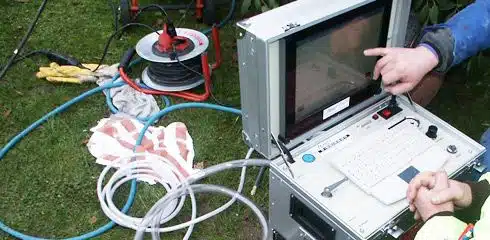
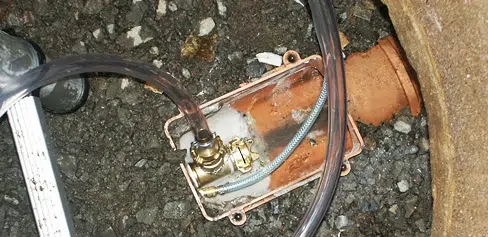
After the test is completed, the test result can be immediately printed as a graphical representation in the pressure measurement diagram, allowing for on-site determination of whether tightness was confirmed for the section being tested.
Wastewater sewers must be tight. Leaky wastewater sewers pollute groundwater and soil. The water tightness of wastewater sewers and pipes must be ensured according to the test requirements of DIN EN 752-2.
The standard procedure is tightness testing in pipes and manholes with air. Optionally, tightness testing can also be performed with water.
All essential test standards for the testing application are stored in the test unit’s computer, thereby simplifying the preparation and execution of the pressure test.