Sewer cleaning
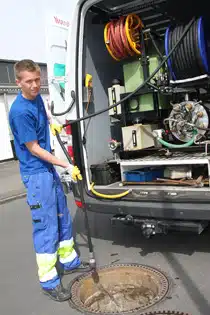
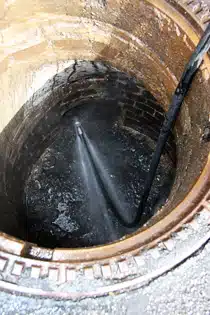
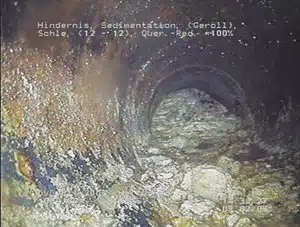
Thorough cleaning of the sewers and manholes to be examined is the basis for a complete inventory and damage assessment of wastewater systems via CCTV sewer inspection. Sewer cleaning is carried out using a combined high-pressure flushing and vacuum vehicle with water recycling. Sediment and deposits are continuously vacuumed up and professionally disposed of.
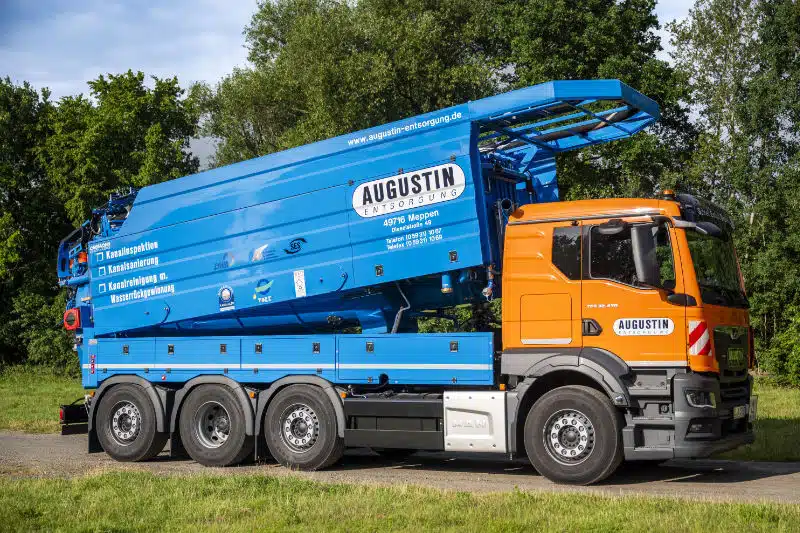
When cleaning connecting collectors, landfill drainage systems, and other difficult-to-access sewer lines, we are capable of cleaning sewer systems up to 600 m in length.
We want everything to stay in flow. Using high-quality technical equipment, our experts clean road gullies, clear blockages, and remove stubborn obstacles using chain cutters and percussion drills. They clean manholes and structures. Quickly, cleanly, and in an environmentally friendly manner, they take care of sewers and pipelines inside and outside of buildings.
Do your interceptor systems need maintenance and cleaning?
We have the expertise and extensive experience. We take the cleaning residues with us immediately for safe disposal. Everything included—that is Augustin Entsorgung.
You can entrust us with the emptying of your three-chamber cesspit as well as the pumping out of septic tanks. We also have the know-how and technology for siphon cleaning and pond desilting. Take advantage of our complete and competent service.
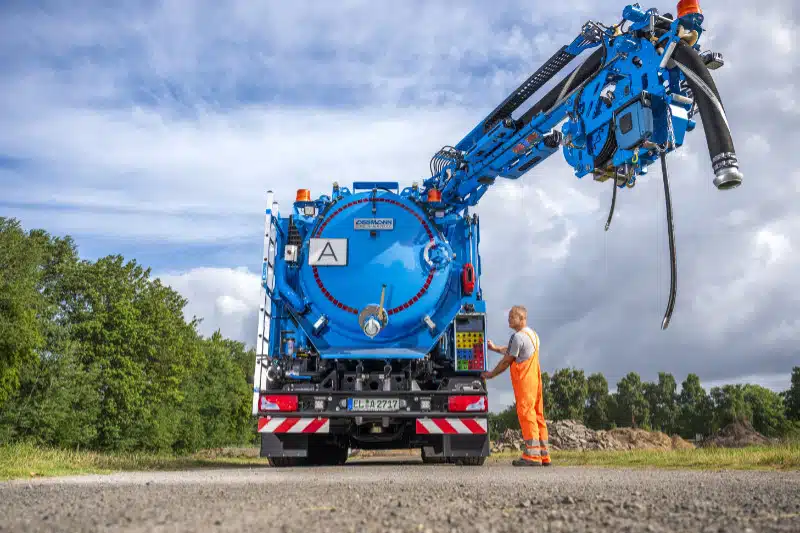
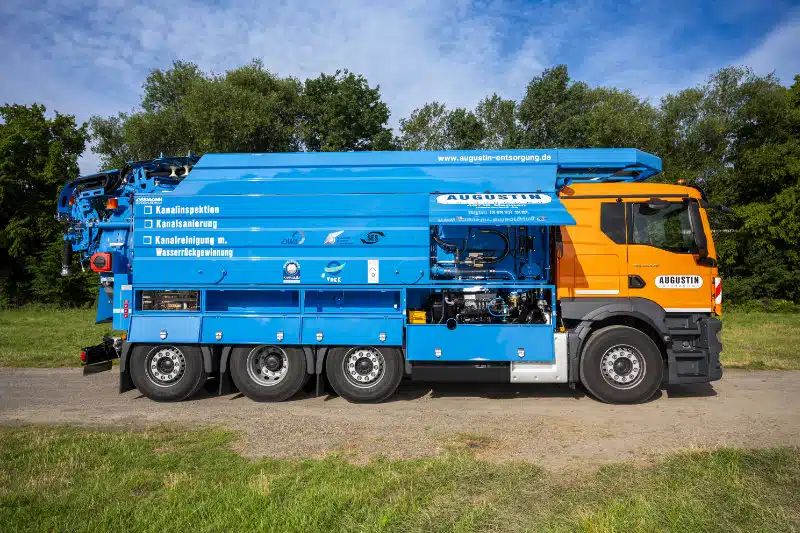
Our combined vacuum and jetter vehicles are in use nationwide, cleaning municipal, commercial, and private wastewater systems.
We distinguish between two configuration variants: one without water recycling and one with.
Vehicles without recycling are primarily used for emptying interceptors and pits, as well as replacing filter materials in swimming pools, waterworks, etc.
The vehicles are equipped with an ejection piston which, depending on the setting, allows between 2 and 10 cbm of water to be held for flushing or the same amount of wastewater to be taken up for disposal and transported to the final disposal site. They carry up to 100 meters of suction hose to reach even the most remote locations. Furthermore, a flushing hose reel is attached to the telescopic arm at the rear of the tank to provide the additional option of cleaning connected inlet and outlet pipes. The telescopic arm can be swiveled up to 90 degrees on both sides, and the arm can also be extended up to 3.00 meters. All of this can be controlled via remote control, so the operator has to do as little manual work as possible. The high-pressure pump generates up to 350 bar and the vacuum pump sucks up to 2,500 cbm per hour. These parameters allow us to achieve success quickly and effectively without great physical exertion.
The variant with water recycling is used where the goal is to achieve the highest possible cleaning performance with the lowest possible use of fresh water. This primarily serves the conscientious treatment of the environment—namely conserving resources, reducing trips to the nearest filling station, and consequently lowering fuel consumption and wear. Due to the special recycling system, the plant is not dependent on fresh water; i.e., water from the return flow of a sewage treatment plant or process water can also be used for flushing.
The coarse separator wall separates coarse materials such as stones and gravel and retains them in the sludge section in the rear area. The self-cleaning water passage is installed in the sludge tank and serves as a pre-sand separation stage and for introducing water into the physical water treatment system. The system constantly adjusts automatically to the level of the sludge water in the sludge tank and positions itself below the surface of the sludge water. The self-cleaning of the water passage takes place constantly against the direction of flow. The cleaning water is continuously provided from the recycling water circuit by means of a centrifugal pump.
The first centrifugal pump transports the pre-cleaned water from the sludge tank via the water passage into the 1st sand separation stage. At the same time, the cleaning water for the self-cleaning water passage is fed into the flushing line.
The cyclone system physically separates fine and ultra-fine sand from the water using centrifugal force under pressure. The separated particles are discharged and automatically returned to the sludge tank. The cleaned water is passed on to the water tank.
The water pre-cleaned in the 1st cyclone system enters the separate water tank. This consists of 5 chambers. Chambers 1-4 are large settling tanks (calming zones) and serve as sedimentation and cleaning areas. The settling area is approx. 8 m2. Here, sludge, solid, and sand particles separate by means of physical gravity separation and sink to the bottom. Optimal settling behavior at every water level is ensured due to the large surface area. To intensify and accelerate the process, the cleanest water is directed from the surface into the next chamber to repeat the settling process there. Chamber 5 serves as a storage chamber for the completely recycled water, which is provided to the high-pressure pump.
The second centrifugal pump transports the pre-cleaned water from chamber 4 of the water tank into two double sand separation stages. The two double cyclone systems physically separate fine and ultra-fine sand from the water using centrifugal force under pressure (centrifugal pump). The separated particles are discharged and automatically returned to the sludge tank. After passing through the system three times, the cleaned water is finally provided to the high-pressure pump via chamber 5 of the water tank.
The treatment capacity of recycled water is 1,200 liters per minute. With an HP pump capacity of 400 liters per minute, there is triple safety in the system. The entire water recycling plant works continuously, without interruption during suction and flushing operations. All processes are controlled and monitored fully automatically via the PLC CAN-BUS computer control. A manual control option for the system is also available. The vehicles with water recycling are equipped with high-pressure pumps of approx. 400 l/min and are capable of building up a pressure of up to 175 bar. Up to 500 meters of flushing hose can be reeled up.
This is particularly advantageous when working on landfills or in confusing terrain, as several sections can be cleaned in one piece without moving the vehicle. The reel, which can be swiveled up to 180 degrees and extended, accommodates both the suction and the pressure hose. As standard, 25.00 m of suction hose DN 100 – 125 is reeled up, with the same length again as a reserve, stowed in the side storage boxes of the vehicle. Standardly, about 200.00 m of HP hose is on it in nominal widths of 1 to 1.25 inches. A distinction is made here between rubber and plastic hoses.
If the task is to clean the longest possible distances, plastic hoses are used because they are lighter and therefore float in the sewer. For smaller diameters with many bends, rubber hoses are used because they are more elastic and easier to steer.
In addition, the vehicles are equipped with a second flushing hose reel. This usually holds up to 100.00 m in 0.5 or 0.75 inches, for smaller nominal widths and for spraying out structures.
Sehende Nordseedüse
According to the current Water Resources Act (WHG), all house connection lines must be inspected every 10 years. The total length of house connections exceeds that of municipal wastewater networks by twofold.
The goal and purpose of these inspections is to avoid unnecessary loads on sewage treatment plants and environmental pollution caused by damaged house connections. Furthermore, damage to municipal and communal infrastructure (sewers, roads, etc.) caused by “blind” flushing or permanent seepage of wastewater is to be prevented, for example, through undermining in damaged sewers or connections.

In the conventional process, jetter and camera vehicles are used one after the other. First, a high-pressure water hose is inserted into the main sewer and it is flushed blindly. The operator has no insight into the main sewer or the house connection.
With the invention and development of the “Sehende Nordseedüse,” a new era of sewer inspection and cleaning has dawned. It is now possible—what was previously only wishful thinking for those responsible—to take a look into the underground sewer system from the large main sewer down to the small-cross-section house connection without having cleaned intensively beforehand.
Cleaning and inspection are always carried out from the main sewer towards the house connections. In contrast, with classic inspection systems, a camera is often lowered into the sewer in the basement or ground floor of a house, which is associated with significant contamination.
The operator can follow the action live at any time via video stream, identify and document damage simultaneously, and drive directly into the house connections thanks to the unique design of the nozzle system and the integrated control.
If damage is identified, problems can be avoided and financial resources conserved. The nozzle is the ideal trailblazer for further inspections of sewers and house connections by camera vehicles.
This system has been used in our company with great success for several years. We are currently operating with 3 systems nationwide.
A flushing demonstration of our combined vacuum and jetter vehicle with water recycling system, Super 2000 from Wiedemann und Reichhardt, in conjunction with the Sehende Nordseedüse.
High-Pressure Flushing – House Connection
In order to determine the condition of the house connection, a thorough cleaning and then a visual inspection of the house connection line must first be carried out.
Cleaning is usually carried out using high-pressure nozzles of various types, which are inserted via inspection manholes or cleaning openings and flush in the direction of the wastewater flow. This high-pressure flushing removes deposits, stubborn encrustations, or other solids within sewers or pipelines. These mostly originate from domestic or commercial wastewater as well as from surface runoff such as roofs or roads.
Cleaning nozzles, root cutters, and special milling cutters ensure the removal of drainage blockages or are used preventively to prevent drainage problems from arising in the first place.
Foundation pipes for foul and rain water, yard drains, drainage systems, inspection manholes, drainage channels, and grease-transporting pipes can be cleaned with a high-pressure jetter.
High-pressure flushing is carried out with pure water without the addition of chemicals. The high-pressure water jets are intended to loosen the adhering solid particles from the pipe or sewer walls and transport them away without damaging the structure of the pipes.